An agent is the main user. A person supervises.
Many tools now add an MCP server. Most stop when the agent has read the numbers. Checkend also measures what the agent did next, and keeps the result.
The three jobs of an agent
Install
You type a domain. Checkend makes an install prompt with an install token for 24 hours. Your coding agent adds the script tag and the goal events, deploys, and checks the first event.
Read
The agent asks questions over MCP, the CLI or the API. Each answer gives the date of the newest data, the sample size and the period before.
Act and learn
The agent makes a change and records it. Checkend measures the result and keeps it. Job 3 is the difference.
The closed loop
- A rule finds a fact
Rules run each hour. A finding has numbers as evidence, for example a page with many impressions and a low click rate. No vague advice.
- The agent claims it
The claim tells other agents and people that the work has started. The finding status is "claimed".
- The agent changes the site
A pull request, a new title, a new page or a fix. The agent records the change as an annotation.
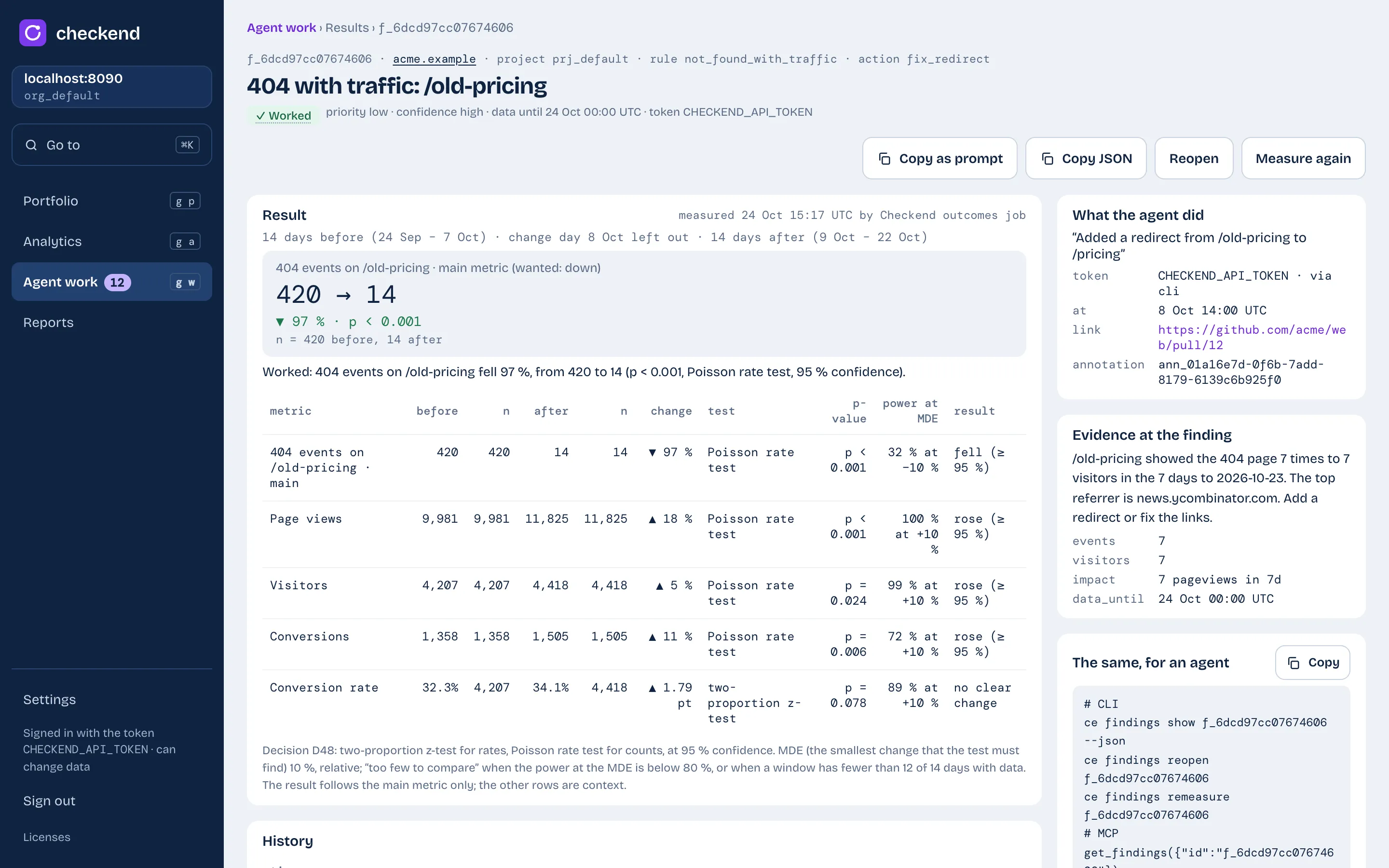
- Checkend measures
14 days before and 14 days after the change, without the change day. A z-test for rates, a Poisson test for counts, at 95% confidence.
- The outcome stays
Worked, no clear change, got worse, or too few to compare. The brief gives it to the next agent run.
"Too few to compare" is an answer.
A small site does not get a false "worked". When the test cannot reach 95% confidence with the data that it has, Checkend says so.
Each site has an outcome sensitivity: the smallest change that the test must find, 10% by default. Each outcome keeps the value that it used.
The first call of each agent run.
Top changes with a significance test, open findings, recent annotations and outcomes, and the data dates. One call, so that a new run starts with the memory of the old ones.
ce brief example.com
# MCP: get_brief {"site": "example.com"}
The data behind the findings
Private analytics
Page views, visitors, sources and channels, goals, conversions and revenue for each currency.
Search Console and Bing
Queries and pages next to visits and conversions. A daily sync keeps the history after the 16 months of Google.
The page crawler
Title, H1, meta description, canonical and indexability of your pages, with robots.txt respected.
Web vitals
LCP, INP, CLS and TTFB from real visitors, as p75 for each page.
AI crawlers
Push an access log, and Checkend keeps the hits of known AI and search crawlers only.
IndexNow
Tell Bing and other engines about changed URLs, with a queue and the last answer.
People check the work
The web UI
A portfolio of all sites, a dashboard for each site with the changes on the chart, and an Agent work page with the findings, the claims and the outcomes. It works on a phone.
Roles and audit
Admin, Member and Viewer. Each token belongs to a person. The audit log keeps each write by a token. Security features are free.